
One chainring at the front, or two? The question comes up at every test ride in the shop, and it is the one that stalls most buyers standing in front of two near-identical bikes.
Good news: both go everywhere. Neither will stop you climbing, or riding fast. The real difference lies elsewhere — and it is simple to grasp. We take it apart here step by step, without jargon, using bikes we have in the shop.
Distances per pedal stroke are calculated for a 700 × 45 mm wheel (2.22 m of circumference). Prices incl. VAT taken from our online catalogue on 8 September 2026, all model years combined. The drivetrains quoted come from the official Giant, Merida, Shimano and SRAM spec sheets.
8 kph
the speed at which you are still climbing. With one chainring just as with two.
46 kph
the speed at which you are still pedalling. With one chainring just as with two.
20 / 12
the number of genuinely different gears. That is where it all happens.
The short answer, if you're in a hurry
You may stop after these two lines. The rest of the article only explains why.
One chainring you ride mostly on tracks, it climbs steeply, and you want nothing to manage while pedalling. Fewer parts, one adjustment less, a chain that does not drop.
Two chainrings your rides mix plenty of road with tracks, and you like pedalling at a steady rhythm for hours. Twice as many usable gears in the zone where you spend your time.
What it is not
→ It is not a matter of ability. Champions win on both.
→ It is not a matter of climbing. Both go equally low, as we show further down.
→ It is not a matter of price: we stock both layouts from €1,700 to €9,000.
→ It is a matter of pedalling comfort — and, often forgotten, of how freely you can change it later.
One pedal stroke — how many metres?
Between 2 and 9 and a half metres, depending on the gear you have selected. That distance has a name — the development — and it is the only piece of jargon in this whole article.
One full turn of the pedals, one distance covered: that is all a development measures. Right at the bottom of your gears, 2 metres. Right at the top, 9 and a half. In between, your drivetrain offers a series of intermediate steps.
Picture a staircase. Right at the bottom, the tiny gears for steep climbs. Right at the top, the big ones for fast descents. A single and a double chainring take you to the same floor: they simply do not have the same number of steps in between.
1.83 m the smallest development on a Merida Silex 700. You are still climbing at 7.7 kph with your legs turning gently, on a 15 % gradient.
4.44 m a middle development, the one for fast tracks: 24 kph at 90 pedal strokes per minute.
9.69 m the biggest development on a Giant Revolt: 46 kph while still pedalling, before you start freewheeling.
For the curious: the maths fits in two lines
→ Divide the chainring teeth (front) by the sprocket teeth (rear). A 42 at the front, a 21 at the back: the answer is 2.
→ Multiply by the wheel circumference, 2.22 m on a gravel bike: 2 × 2.22 = 4.44 m per pedal revolution.
→ And for speed: 4.44 m × 90 pedal strokes per minute = 24 kph. That is every spec sheet decoded.
The myth to drop: « a double has more gears »
That was true ten years ago. Not any more. What counts is the gap between the smallest and the biggest gear — what we call the range. Look at three bikes from our catalogue:
507 % Merida Mission 7000 — two chainrings (48/31), 11-36 cassette
510 % Merida Silex 700 — one chainring (42), 10-51 cassette
460 % Merida Mission 10K — one chainring (44), 10-46 cassette in 13 speeds
So the widest single in our catalogue goes further in both directions than the most complete double. If someone tells you that you need two chainrings to climb, they are describing bikes from before 2020.
What changed everything: the small 10-tooth sprocket
→ One 44-tooth chainring with a 10-tooth sprocket gives you exactly the same big gear as a 48-tooth double with an 11-tooth sprocket.
→ In other words: the small sprocket at the back replaced the big chainring at the front.
→ As a result, a single gives up nothing in top speed. It has only one genuine drawback left, and that is the subject of the next chapter.
The real difference: the height of the steps
Back to the staircase. On your rear wheel, the sprockets are lined up smallest to largest: moving from one to the next is one step up or down. And not every step is the same height.
The height of a step is easy to measure: it is the sudden slack — or the sudden resistance — you feel in your legs the moment you shift.
An example everyone has already lived through
→ You are riding on the flat at 85 pedal strokes per minute. Comfortable — you could keep it up for hours.
→ You take a small step: you are now at 79 strokes. You do not even notice.
→ You take a big step: you drop to 71. Now you feel it in the legs — and you go looking for the in-between gear, which does not exist.
A single chainring has exactly as many gears as its cassette has sprockets: 12 sprockets, 12 gears, so 11 steps. A double stacks two sets that slot into each other — the big ring's and the small ring's. The result: 20 genuinely different gears, so 19 steps across the same staircase. Twice as many steps over the same height: they are necessarily shallower.
Here are the two staircases, step by step. Each bar is one shift, and its height is the size of the hole you will feel in your legs. Read left to right, from the climbing gears to the descending ones; the red bars are the fast half, the flat, where you spend the most time. The lower, the better.
A double chainring — 48/31 with an 11-36 cassette
20 genuinely different gears, so 19 steps. Heights: 3 to 17 %.
Each bar = one step, the figure above it gives its height in % · in red, the fast half (flat and descent) · the lower the bar, the better
A single chainring — 42 with a 10-51 cassette
12 gears, so 11 steps. Heights: 13 to 20 %.
Each bar = one step, the figure above it gives its height in % · in red, the fast half (flat and descent) · the lower the bar, the better
Look at the red half, where you spend your hours. On the double, the steps there are mostly 3 to 9 %, with two exceptions at 12 and 13 %. On the single they never drop below 12 % and climb to 20 %.
Translated onto the bike: with a double, you almost always find the gear that suits you. With a single, you will sometimes hesitate between two — one a touch too hard, the other a touch too easy. That is the only real price of simplicity.
And what if you want to change your gearing later?
Here is the point almost everyone forgets at the moment of buying, and it is our mechanic who raises it. You keep a bike for five or ten years. Your legs, your rides and your terrain do change.

« On a single chainring, changing your gearing is one part and one visit to the workshop: we swap the ring, shorten the chain or replace it, and that's that. Even on high-end kit. On a double, you get stuck quickly: very few chainring pairs exist, and then the front and rear derailleurs still have to cope. »
Maximilien — bike advisor & mechanic, KAMEO Bikes Liège
The manufacturers' catalogues prove him right, and dramatically so:
5 sizes SRAM XPLR single chainrings fit the same crank in 38, 40, 42, 44 or 46 teeth — and up to 52 teeth in the aero version. You change one part, everything else stays put.
2 combinations on a double, Shimano GRX only offers 48/31 or 46/30. Chainrings come in pairs: you do not pick the big one and the small one separately.
17 teeth the maximum difference the GRX front derailleur accepts between the two rings. Beyond that it will not lift the chain. That is where your room to manoeuvre ends.
The wall you don't see coming
→ The rear derailleur on a 12-speed GRX double is designed for 11-34 or 11-36 cassettes. Shimano writes it into the product name itself.
→ To go lower for climbing you would need a derailleur that does not exist in a double version — whereas the same groupset, as a single, accepts a cassette up to 51 teeth.
→ Put plainly: with one chainring you adjust your gearing the day your terrain changes. With two, you live with what came on the bike.
The single chainring, in short
One ring, one derailleur, one control. Nothing left to decide at the front: you shift up, you shift down, the chain follows.
What it gives you
→ Nothing to manage at the front. At 12 % in wet leaves, nobody wants to anticipate a front shift.
→ The chain stays put. The ring's teeth alternate thin and thick: they hold it through the hits.
→ Fewer parts. The front derailleur alone weighs 96 g; add the second ring and its shifter. A few hundred grams, and above all one adjustment less to wear out.
→ A bike that adapts. You can change your gearing later without breaking anything (see above).
What it costs you
→ Taller steps, especially in the fast gears. That is the familiar « hole » you hunt for on the flat.
→ Slightly lower efficiency. On the test rig, a single lost 12.2 W on average against 9.5 W for a double. Around 3 W: real, but you will not feel it.
→ Concentrated wear on one ring and two or three sprockets.
In our shop, the Merida Silex 700 at €2,299 is the perfect example for rough tracks, and the Merida Mission 10K shows how far the formula can be pushed.
The double chainring, in short
Two rings, a front derailleur, one more control under the left hand. In exchange: twenty genuinely distinct gears, and steps half as tall where you spend your hours.
What it gives you
→ Pedalling comfort. On a long fast section you stay within five pedal strokes of your ideal rhythm, always.
→ Road-then-track sequences. Belgian gravel is often 20 km of tarmac to reach 30 km of tracks: that is what the big ring is for.
→ Wear spread over two rings, and a chain running crooked less often.
What it costs you
→ One more adjustment, one more control, a little weight.
→ One move that goes wrong. Shifting rings halfway up a ramp, with force on the pedals, stays delicate.
→ Little room to evolve: two chainring pairs, and no wider cassette possible.
The Giant Revolt 1 at €1,749 and the Merida Silex 4000 show that a well-spaced double stays very affordable; the Giant Revolt Advanced 2 and the Merida Mission 7000 take it to 12 speeds, right up to electronic shifting.
And on the tracks around here?
Between Hesbaye and the Ardennes there are two different gravel disciplines. The right choice is read first from last year's rides.
RAVeL, Hesbaye flat, fast, tarmac and crushed limestone. You spend the ride between 3 and 6 metres per pedal stroke, hunting the right rhythm for three hours: the double is at home here.
Condroz, Ardennes short 12-15 % ramps, often on greasy tracks, strung together all day. You go right down the cassette and stay there: the single is at home here.
Bikepacking 10 to 15 kg of luggage changes the whole reasoning. The priority becomes the very smallest gear, whatever the number of chainrings.
The simple check to run before you buy
→ Count the chainring teeth, then the teeth on the biggest sprocket of the cassette. You want at least as many at the back as at the front (42 × 42, 40 × 40).
→ That gives you around 8.5 kph with your legs turning gently: below that speed you can no longer hold a line on a track.
→ Loaded, or if the Ardennes are your playground, aim lower still: a 42 chainring with a 51 sprocket drops to 1.83 m per pedal stroke.
The thirteenth gear, the real recent progress
The single's weakness is its tall steps. The manufacturers' answer was not to put a chainring back, but to add a sprocket. Here is SRAM's 13-speed cassette, the one on the Merida Mission 10K:
A recent single chainring — 44 with a 10-46 cassette in 13 speeds
13 gears, so 12 steps. Heights: 8 to 21 %.
Each bar = one step, the figure above it gives its height in % · in red, the fast half (flat and descent) · the lower the bar, the better
The first three steps come back down to 10, 9 and 8 %: exactly the level of a double, with one chainring. The tall steps have been pushed right to the bottom of the cassette, where you are climbing and where you do not care. That is why the single took over gravel racing.
Six gravel bikes from the catalogue, six drivetrains
Each entry lists the exact build as stated by the manufacturer. That is the line to read before the weight and before the colour.
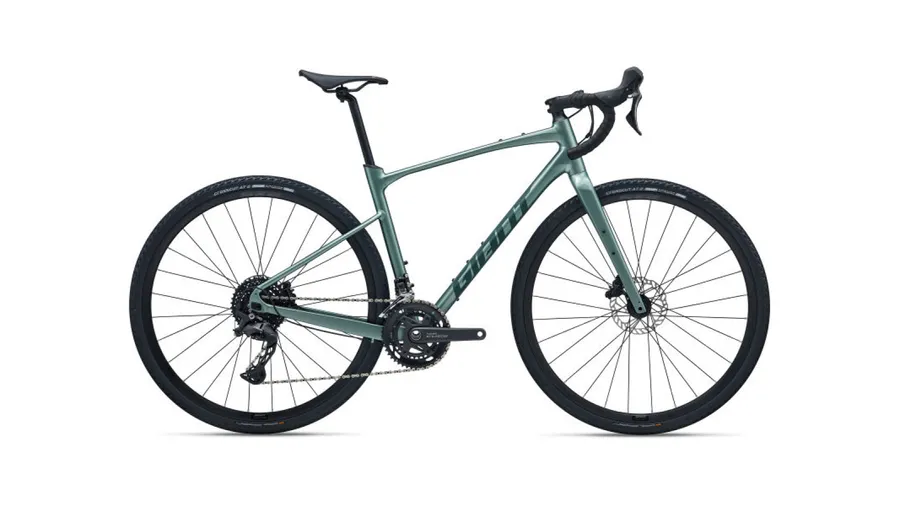
Two chainrings (48/32), 11-34 cassette in 10 speeds. Fine steps at an entry price: the all-round gravel bike that eats as much road as track.
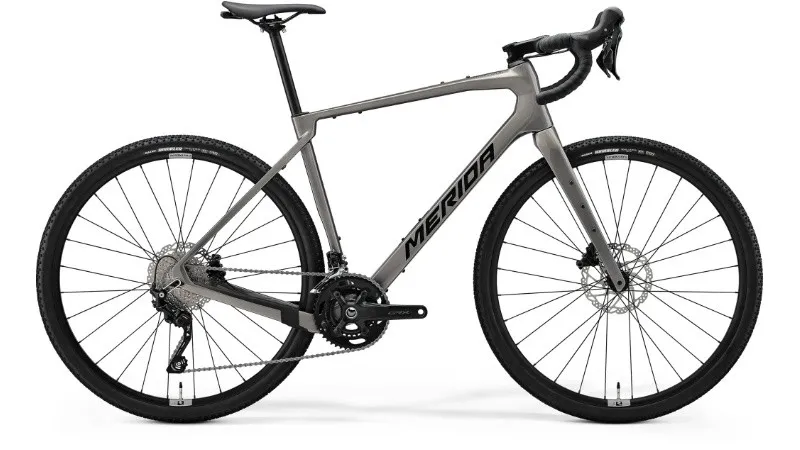
Two chainrings (46/30), 11-36 cassette in 10 speeds. The 30-tooth small ring goes very low: carbon frame, adventure spirit, the smoothness of a double.
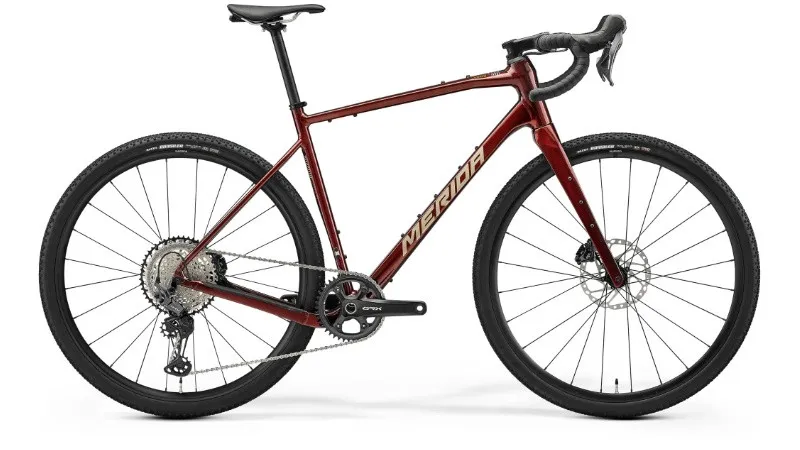
One chainring (42), 10-51 cassette in 12 speeds. The widest range in our catalogue on a single ring: the benchmark for rough tracks.
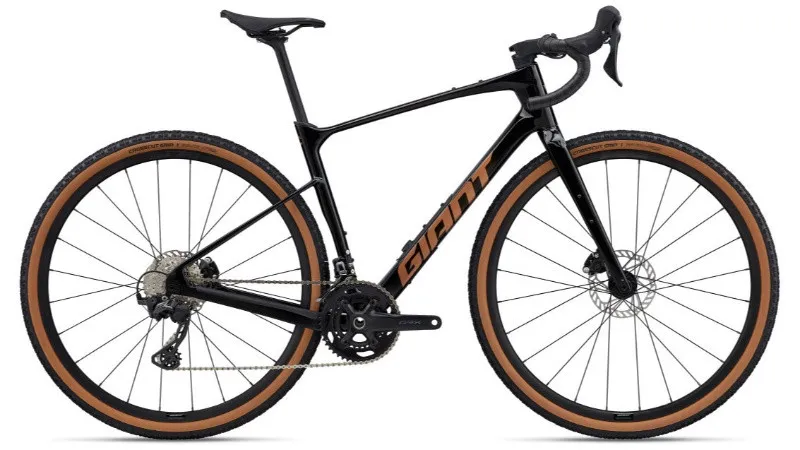
Two chainrings (48/32), 11-36 cassette in 12 speeds. Carbon frame and twenty genuinely distinct gears: the modern double in its finished form.
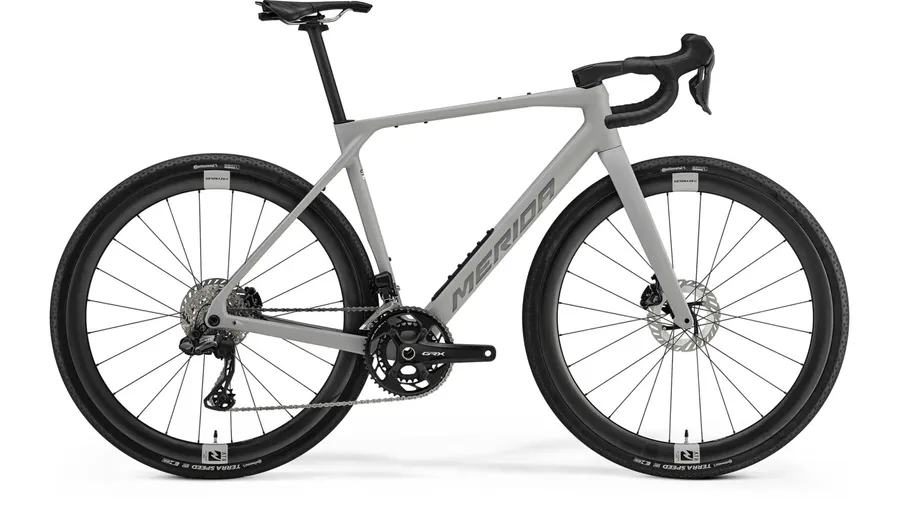
Two chainrings (48/31), 11-36 cassette in 12 electronic speeds. The front shift is handled by the bike, no longer by your wrist.
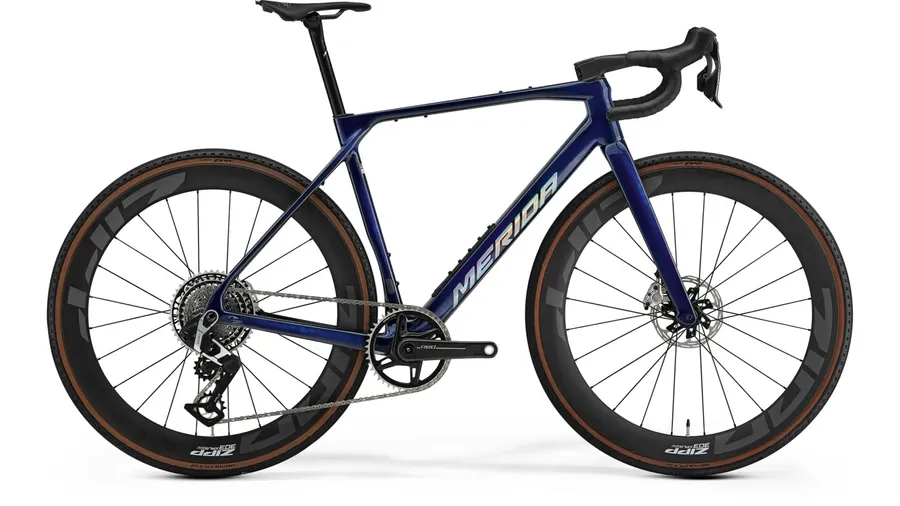
One chainring (44), 10-46 cassette in 13 speeds (SRAM Red XPLR AXS). The thirteenth sprocket brings the first steps back to the level of a double.
The questions we get in the shop
I'm new to gravel — which one do I take?
Look at your rides, not at your dreams. If they include more than 20 km of road and little elevation, a double will give you more pedalling comfort for the same budget. If they are short, steep and dirty, take the single and stop thinking about it. Below €2,000, the double is often the better spaced of the two.
I'd like easier gears for the mountains. Is that possible?
With a single chainring: yes, and it is simple. We go, say, from a 44-tooth ring to a 40-tooth one, adjust the chain, and every one of your gears becomes 10 % easier. One part, one workshop visit. With a double: far more constrained. Only two chainring pairs exist, the difference between them cannot exceed 17 teeth, and the cassette cannot go beyond 36 teeth. Often the only real answer is a different bike.
Can I convert a double into a single?
At the crank, yes: remove a ring, the front derailleur and its shifter. But if the cassette stays an 11-34, you lose the small ring and gain nothing at the back, and the bike climbs worse than before. A genuine conversion also needs a wide cassette and a rear derailleur able to handle it. That costs money: talk to us before you take anything apart.
Does a single wear the drivetrain out faster?
A little, yes: one ring takes all the effort, and the chain runs at an angle more often at the ends of the cassette. It is measurable in efficiency, about one percentage point, and it shows mostly in chainring life. Regular cleaning and lubrication matter far more than the single-or-double choice.
What about an electric gravel bike?
The reasoning holds, with one nuance: the motor smooths out part of the gap between gears, so a single's tall steps are less noticeable. Come and try one — it is the only honest way to decide.
Torn between the two? Come and swing a leg over.
Our gravel bikes are listed online and available to test ride in Liège and in Brussels. Ten minutes on the bike settles it better than any table.