
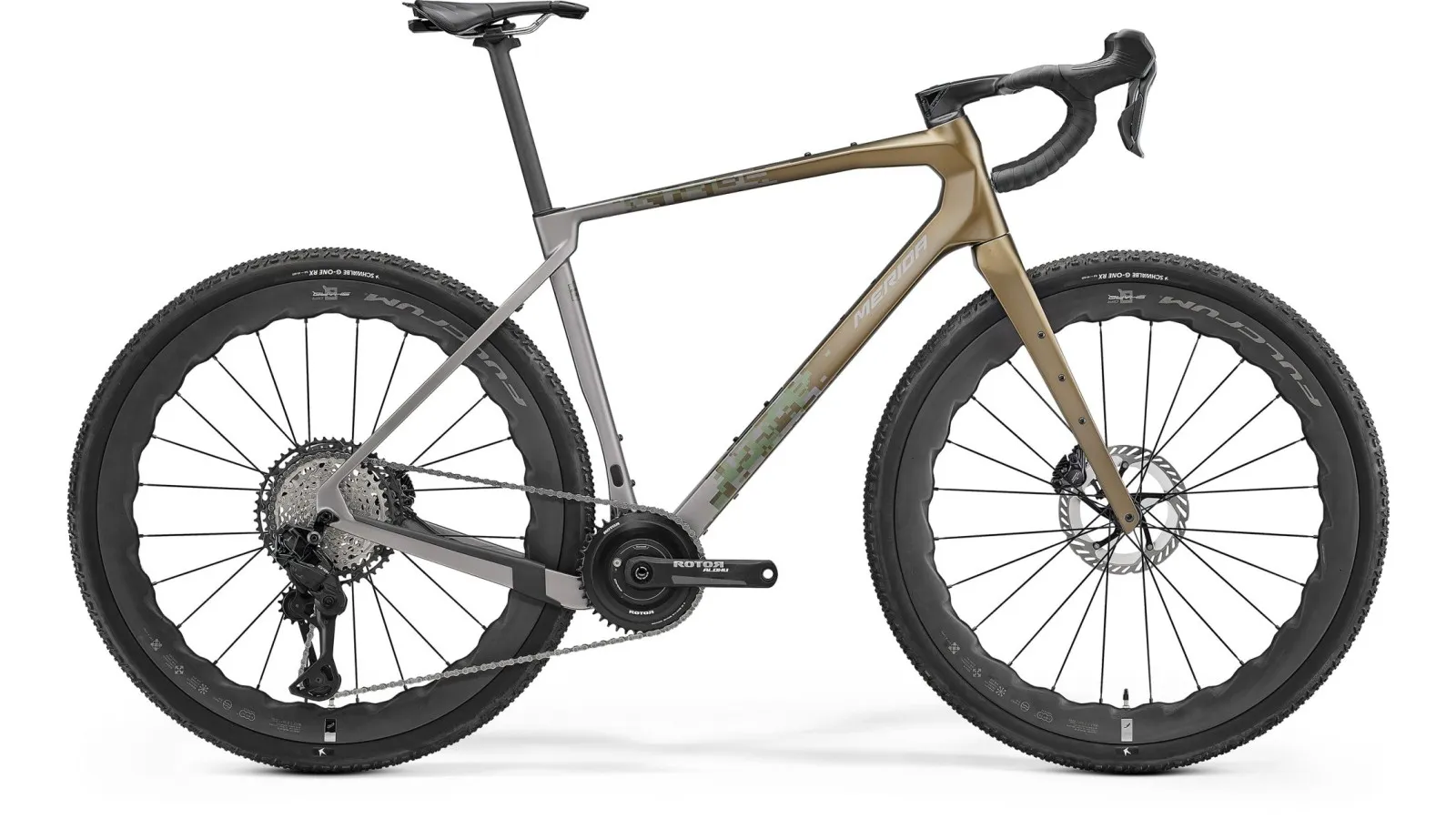
The SILEX is Merida's adventure gravel bike: mountain-bike-inspired geometry, big tyres and mounting points everywhere. It also happens to be the bike Matej Mohorič rode to the Gravel World Championship title. Ever since, the same remark kept coming back from owners and reviewers alike: the frame is excellent, but its build holds it back as soon as the pace rises.
Merida has just answered with a new variant: the SILEX RS. Two models, the SILEX RS 9000 and the SILEX RS 7000. The idea is deliberately simple: leave the frame, the geometry and the tyre clearance untouched, and change only the three parts that cost watts.
In this article: exactly what changes, what it is worth against the standard SILEX, what reviewers say about the platform, and how to choose between SILEX, SILEX RS and MISSION.
2
models: RS 9000 and RS 7000
45 mm
of tyre, just like the adventure SILEX
6
sizes, from XXS to XL
A SILEX, dressed to go fast
Merida puts it plainly: the RS "adopts the key principles of the SILEX" and goes "one step further to get it race-ready". In practice, the list of what does not change is longer than the list of what does.
Identical to the SILEX
- SILEX CF2 II carbon frame and carbon fork
- Full geometry: 69.5° head angle, 430 mm chainstays
- 700 × 45C clearance (47C at the fork)
- Six sizes, from XXS to XL
- Mounting points for kit and nutrition
- 1×12 drivetrain with a 10-51 cassette
- 180 mm rotors front and rear
What the RS adds
- Carbon Fulcrum wheels with an aero profile and extra-wide rim
- One-piece Vision cockpit (bar and stem in one)
- Rotor crankset with an aero chainring
- FSA ACR headset: fully internal cable routing
- Electronic Di2 shifting on both models
The real headline: Fulcrum rims with a 30 mm internal width
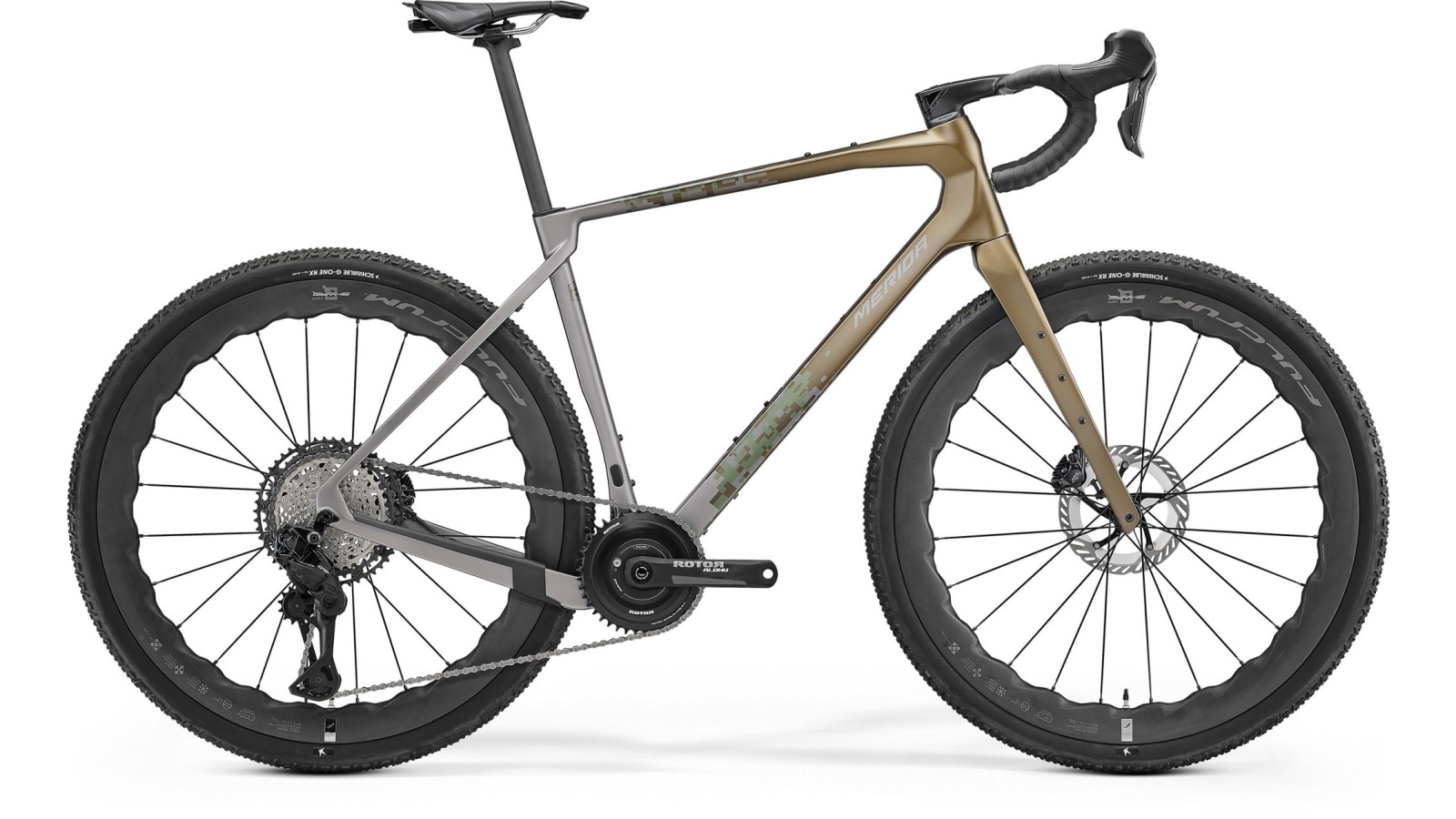
This is by far the most consequential change. The RS 9000 gets the Fulcrum Sharq GR, the RS 7000 the Soniq GR — two new wheelsets designed for fast gravel.
Their signature: a 30 mm internal rim width (up from 25 mm on the previous generation) and a wavy, variable-depth profile of 47/52 mm. Fulcrum optimises them for 47 to 50 mm tyres, now the standard width in racing. In practice, the stock 45 mm tyre sits wider, holds its shape better and allows a broader pressure range — so more grip and comfort without losing efficiency. The rim bed is undrilled: no tubeless tape required.
| Wheels | On which bike | Internal width | Claimed weight |
|---|---|---|---|
| Fulcrum Sharq GR (carbon) | SILEX RS 9000 | 30 mm | 1,550 g |
| Fulcrum Soniq GR (carbon) | SILEX RS 7000 | 30 mm | 1,695 g |
| Reynolds ATR (carbon) | SILEX 9000 | 25 mm | — |
| Shimano RX180 (aluminium) | SILEX 7000 | 25 mm | — |
For scale: bought separately, these wheelsets sell for around €1,990 (Sharq GR) and €1,290 (Soniq GR). On their own they account for much of the price gap between a SILEX and a SILEX RS.
One-piece cockpit and aero chainring: the detail with a trade-off
Both RS models get a one-piece Vision 5D SMR bar-and-stem, in widths of 380 mm (XXS to S), 400 mm (M and L) and 420 mm (XL), on a 90 or 100 mm stem. Combined with the FSA ACR headset, every cable runs internally: nothing catches the wind, and cleaning after a muddy ride is far simpler.
The crankset follows the same logic: a Rotor with a 42-tooth aero chainring — ALDHU on the RS 9000, Vegast on the RS 7000.
The caveat, which we would rather flag before you buy: a one-piece cockpit means a fixed bar width and a fixed stem length. You cannot correct a poor choice with a €60 part. On a bike built for six-hour rides, the fit is therefore decided when you order, not afterwards. It is exactly the kind of thing that takes ten minutes to settle with a tape measure and a test bike in the shop.
SILEX RS or SILEX: the table that settles it
| SILEX RS 9000 | SILEX 9000 | SILEX RS 7000 | SILEX 7000 | |
|---|---|---|---|---|
| Price | €6,499 | €5,499 | €4,799 | €2,999 |
| Drivetrain | GRX RX825 Di2 | GRX RX825 Di2 | GRX RX717 Di2 wireless | GRX 820 mechanical |
| Wheels | Fulcrum Sharq GR carbon | Reynolds ATR carbon | Fulcrum Soniq GR carbon | Shimano RX180 alloy |
| Cockpit | One-piece Vision | Carbon bar + alloy stem | One-piece Vision | Alloy bar + alloy stem |
| Crankset | Rotor ALDHU, 42T aero | Shimano GRX 42 | Rotor Vegast, 42T aero | Shimano GRX 42 |
| Frame and geometry | Strictly identical across all four bikes | |||
The RS 7000 makes the most dramatic jump: against the SILEX 7000 it gains wireless electronic shifting and carbon wheels in one go. The RS 9000 starts from an already well-equipped bike, so its gap is purely about aerodynamics and rim width.
What does not move a millimetre
This is the key point if you are hesitating: moving to the RS does not force you into a racer's position. The geometry is the SILEX's, unchanged.
| Size | Reach | Stack | Wheelbase | Head angle |
|---|---|---|---|---|
| S | 402 mm | 588 mm | 1,065 mm | 69.5° |
| M | 412 mm | 607 mm | 1,082 mm | 69.5° |
| L | 426 mm | 626 mm | 1,104 mm | 69.5° |
| XL | 441 mm | 645 mm | 1,126 mm | 69.5° |
A high stack, a slack head angle and a long wheelbase: a position still bearable after four hours, and a bike that stays reassuring down a broken track. The fork also keeps its 415 mm length, which leaves the door open for a short-travel suspension fork later without upsetting the geometry.
What the press says — and why the RS exists
To be clear: the SILEX RS has only just been unveiled, and no independent review of these two specific models has been published yet. The frame and geometry they use, however, have been tested everywhere since launch. And the verdicts are strikingly consistent.
BikeRadar — SILEX 7000
Rated 4/5 and a "Gravel Bike of the Year" contender. Strengths: capability, confident handling, versatility, value. Reservation: 10.22 kg in size L, "a little weighty" against rivals.
Cyclist — first ride
Descending judged exceptional, "poised and composed" through turns. Reservation: it felt "upright and ponderous to accelerate" on tarmac.
GRAN FONDO — gravel race group test
On the SILEX 8000: "outstanding composure and stability", but the heaviest bike of the field (8.96 kg in M) and sluggish acceleration, blamed on heavy wheels and slow-rolling tyres.
The pattern is hard to miss: nobody criticises the frame. The reservations are always about weight and acceleration — that is, wheels, tyres and cockpit. The SILEX RS does nothing other than fix precisely those three items, without touching what everyone likes. Worth remembering, too: this frame took the Gravel World Championship title under Matej Mohorič. The race potential was already there; it was missing the right outfit.
SILEX, SILEX RS or MISSION?
Merida now offers three gravel families that follow one another without overlapping. Here is how we separate them in the shop.
SILEX
The adventure gravel bike. Bikepacking, luggage, rough tracks, long days with no stopwatch. From the entry-level alloy model to carbon with Di2. From around €1,349.
SILEX RS
The same bike for riders who go fast and far: ultra-distance, demanding gravel events, big fast rides. SILEX comfort and clearance, race-bike equipment. €4,799 and €6,499.
MISSION
Pure racing, road-influenced. A markedly lower and shorter position than the SILEX, clearance limited to 40 mm. For riders coming from the road who put the clock ahead of comfort.
In short: if you were torn between a SILEX you found too sedate and a MISSION you found too extreme, the RS is exactly the box that was missing.
SILEX RS 9000 and SILEX RS 7000 in detail
SILEX RS 9000 — €6,499
Silk Gold / Slate Grey. Electronic Shimano GRX RX825 Di2 1×12, 10-51 cassette, Rotor ALDHU crankset with a 42-tooth aero chainring. Fulcrum Sharq GR carbon wheels. Shimano GRX brakes with 180 mm rotors. Schwalbe G-One RX tyres in 45 mm, tubeless ready. Carbon seatpost, Prologo Scratch M5 AGX saddle.
See the SILEX RS 9000 →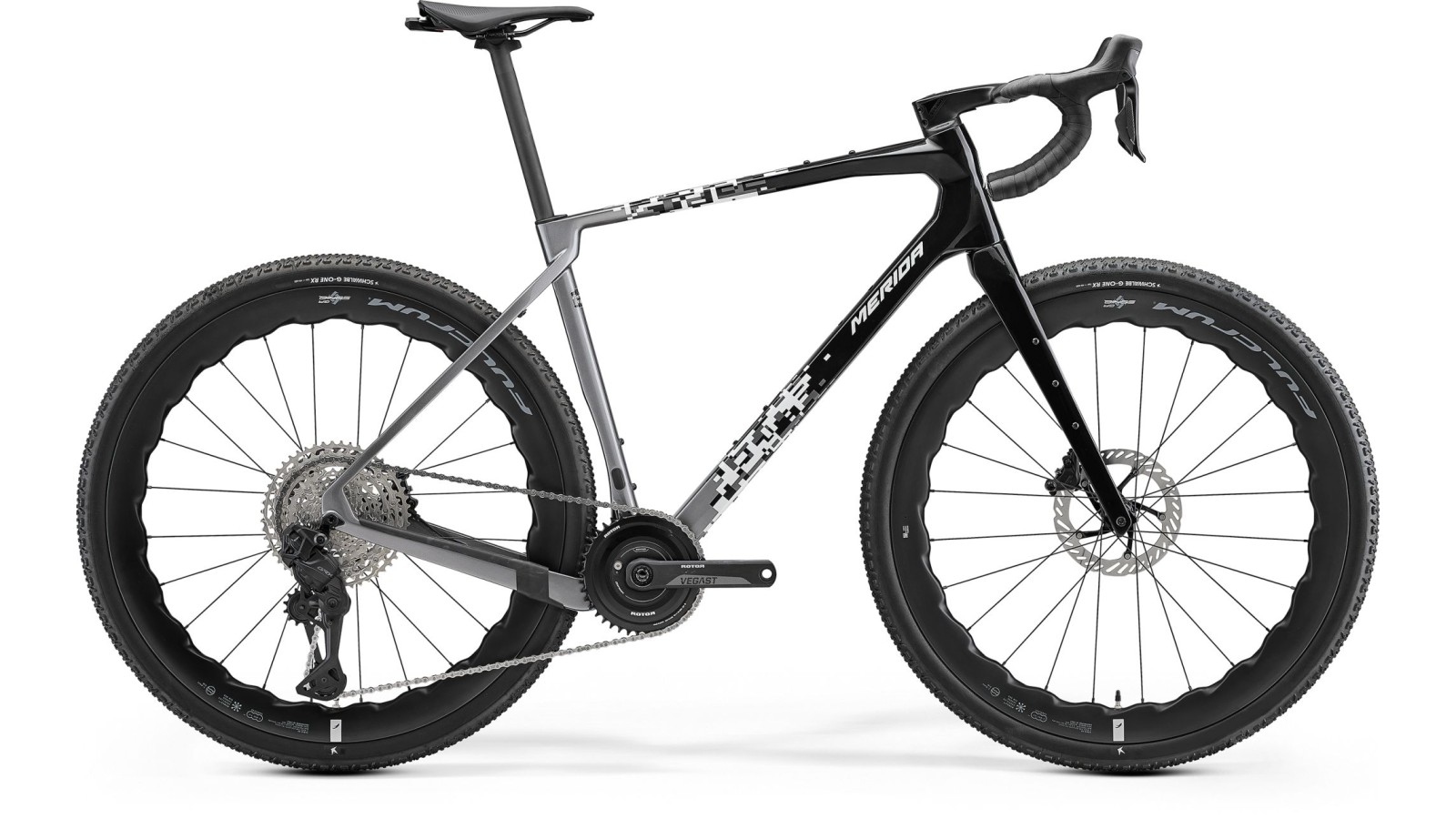
SILEX RS 7000 — €4,799
Metallic Black / Grey. Shimano GRX RX717 Di2, GRX's new wireless electronic tier, in 1×12 with a 10-51 cassette and a Rotor Vegast crankset with an aero chainring. Fulcrum Soniq GR carbon wheels. 180 mm rotors, Schwalbe G-One RX tyres in 45 mm. To our eyes, the better value of the two.
See the SILEX RS 7000 →Frequently asked questions
Is the SILEX RS less comfortable than the SILEX? +
No, and that is the whole point. Frame, fork, carbon seatpost and geometry are identical, and the tyre stays 45 mm — on a wider rim, which even allows slightly lower pressures. The only real comfort difference comes from the one-piece cockpit, stiffer than a carbon bar on a conventional stem.
Can I still go bikepacking on it? +
Yes. The frame keeps its mounting points for kit and nutrition, exactly as on the SILEX. Merida even puts that forward as an argument for the RS: ultra-distance events require carrying supplies, and the bike is built for it.
Can I fit tyres wider than 45 mm? +
The frame is rated for 700 × 45C and the fork accepts 47C. The Fulcrum rims are optimised for 47 to 50 mm, so the limiting factor is the frame, not the wheel. We recommend staying within the manufacturer's stated figures, if only for the warranty.
Which size should I choose? +
Six sizes are available, from XXS to XL. On a bike with a one-piece cockpit, that question deserves ten minutes of measuring rather than an online chart: bar width and stem length are dictated by the frame size. Come to the shop, we take your measurements and compare them with your current bike.
Can I finance it through my employer? +
In most cases, yes. Bike leasing, cafeteria plans and the mobility budget cover a carbon gravel bike just as well as a city bike, often halving the net cost. Tell us who you work for and we will check what is already in place.
Want to try a SILEX before ordering your RS?
Both SILEX RS models can be ordered in all six sizes. Advice, fitting and test rides at our Liège shop, Quai de Rome.