
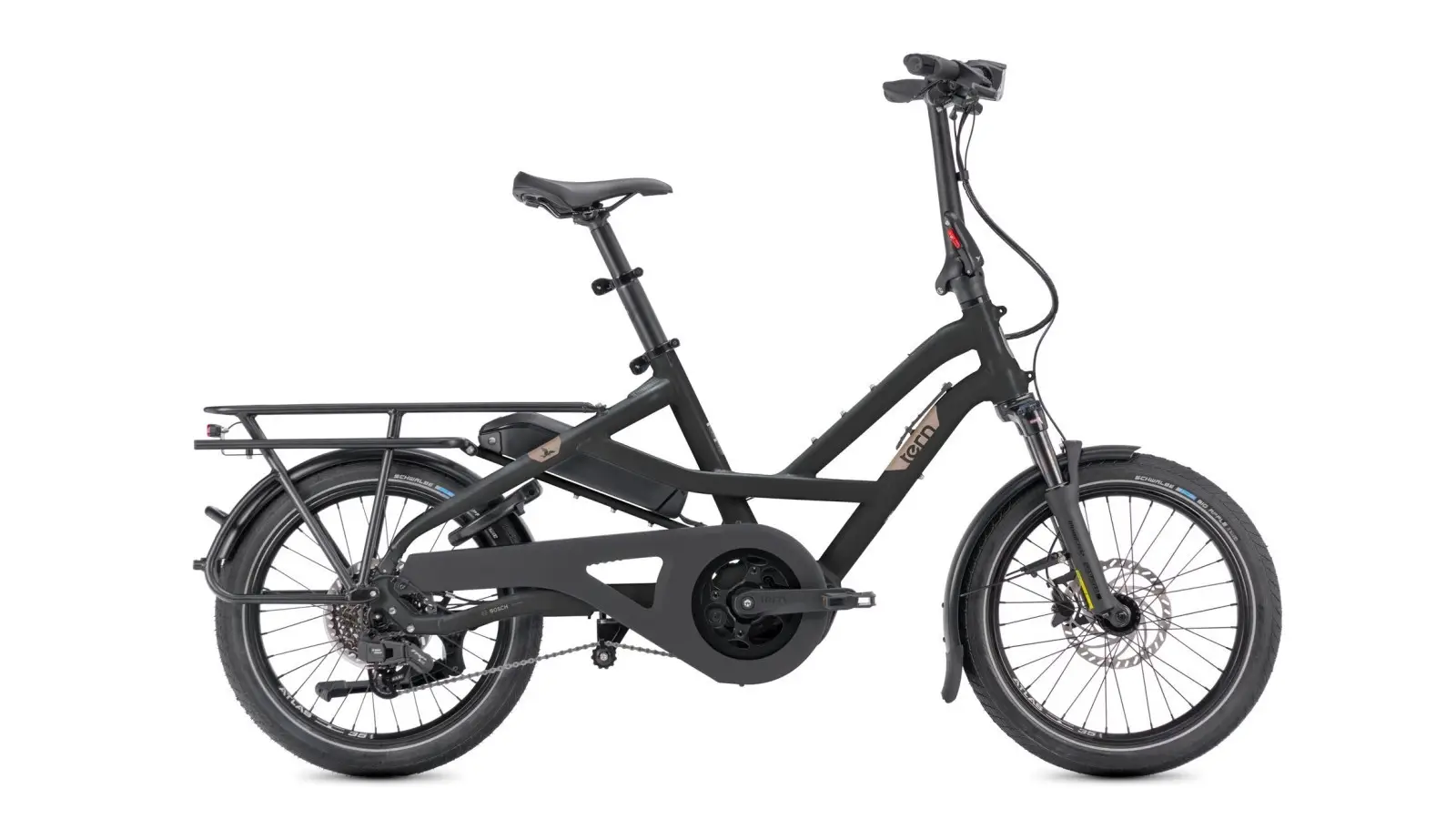
The HSD is Tern's compact cargo bike: 174 cm long, barely longer than a city bike, yet its rear rack carries 80 kg. Enough for a child, a light adult or the week's shopping, and you can still park it upright in a hallway.
Tern has just launched the third generation of the HSD, and the P10e replaces the HSD P10, the derailleur model of the range. On paper, much looks the same: the same 75 Nm Bosch motor, the same 545 Wh battery, the same 20-inch wheels. The real differences lie elsewhere: in the frame, the shifting and the components. We go through them with Tern's official figures.
Specifications: Tern's official spec sheets for the HSD P10 (Gen 2) and HSD P10e (Gen 3). Prices: KAMEO catalogue on 5 October 2026, VAT included. Bike names are clickable.
190 kg
maximum gross weight, up from 180 kg on Gen 2
Auto
wireless shifting, with an optional automatic mode
4 999 €
retail price of the HSD P10e Gen 3
What stays the same
The HSD concept is unchanged: a short, folding bike that is strong enough to replace the car for everyday trips.
The format
→ 20-inch wheels, 174 cm long
→ handlebar and saddle fold down in 5 seconds for a car boot or a lift
→ stands upright on its rear rack for storage (Vertical Parking)
The drive system
→ Bosch Performance Line motor, 75 Nm, up to 340% assistance
→ Bosch PowerPack 545 Wh battery
→ Bosch Smart System: eBike Flow app, eBike Lock, over-the-air updates
The rear rack
→ Atlas H, 80 kg capacity, same as Gen 2
→ 55 mm Schwalbe Big Apple tyres, Tern Valo Direct lighting, Ursus rear kickstand
A redesigned frame that carries more
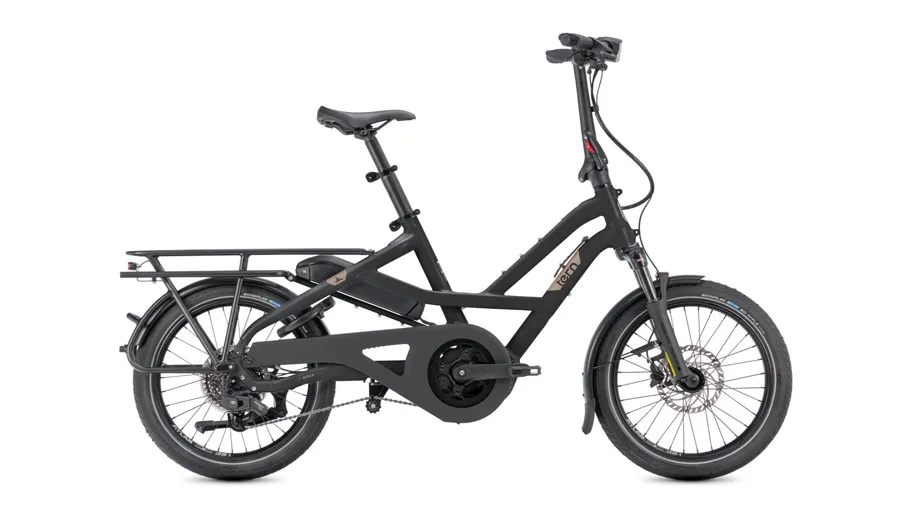
This is the least visible change and the most important one. Tern describes a frame that is “even stiffer, flexing minimally under load”, with a longer wheelbase and a lower centre of gravity.
GROSS WEIGHT 180 kg → 190 kg (bike, rider and load combined), certified to the EN 17860 cargo bike standard
RIDER 120 kg → 130 kg maximum
RIDER HEIGHT 150–195 cm → 150–200 cm
WHEELBASE lengthened to 119 cm: more stable with a passenger on the back
HANDLEPOST Andros → Physis 3D, forged, adjustable and foldable without tools
SEATPOST wider seat tube and a new, sturdier 41 mm Tern VLT seatpost
In practice: when your child moves around on the back or the panniers are full, the bike stays calmer. And tall riders, who sometimes had to improvise with the Gen 2 handlepost, now get a comfortable position straight out of the box.
The real news on the P10e: it shifts by itself
The “e” in P10e stands for electronic shifting. The HSD P10 Gen 2 used a conventional cable-operated Shimano Deore derailleur. The P10e goes wireless.
HSD P10 (Gen 2)
→ Shimano Deore 10-speed, trigger shifter and cable
→ 11-36 tooth cassette
HSD P10e (Gen 3)
→ wireless TRP E.A.S.I. A10 derailleur, controlled by Bosch eShift
→ automatic mode: you choose your pedalling cadence, the system changes gear
→ the motor briefly eases off at each shift: smooth changes, even when loaded
→ no more cables to stretch or get dirty
An easier first gear
→ Shimano CUES Linkglide 11-39 cassette, built to last
→ gear range of 2.18 to 7.72 m, versus 2.36 to 7.72 m
→ first gear is about 8% easier: setting off uphill with a child gets easier
Early published reviews praise how smooth the system is. The one limitation noted: automatic mode can't anticipate a sudden climb. A manual shift on the handlebar, always available, sorts that out.
Brakes, display, lock: the details that matter
Brakes
The Tektro hydraulic brakes (180 mm front rotor, 160 mm rear) give way to Magura hydraulic brakes with two 180 mm rotors. More bite at the rear, where the load sits.
Display
The Intuvia 100 and its remote are replaced by a Purion 200, compact and built into the handlebar. All Smart System functions run through the eBike Flow app.
Lock and fork
AXA frame lock, opened with the same key as the battery. Suntour fork developed for Tern, also certified for 190 kg.
The comparison at a glance
HSD P10 (Gen 2)
HSD P10e (Gen 3)
Motor
Bosch Performance Line, 75 Nm
Bosch Performance Line, 75 Nm
Battery
545 Wh
545 Wh
Claimed range
51 to 121 km
56 to 107 km
Gears
Shimano Deore 10-sp., cable
TRP E.A.S.I. 10-sp., wireless, auto
Cassette
11-36
Linkglide 11-39
Brakes
Tektro, 180/160 mm
Magura, 180/180 mm
Display
Intuvia 100
Purion 200
Gross weight
180 kg
190 kg
Max. rider
120 kg
130 kg
Rear rack
80 kg
80 kg
Rider height
150–195 cm
150–200 cm
Weight
27.6 kg
28.3 kg
Folded (L × W × H)
165 × 39.5 × 87 cm
166 × 42 × 87 cm
KAMEO price
4 799 €
4 999 €
Sources: Tern's official spec sheets. Prices: KAMEO catalogue on 5 October 2026, VAT included.
Where Gen 3 doesn't do better
A new generation isn't better on every count. Three things to know before you choose.
A little heavier, a little wider
→ 28.3 kg versus 27.6 kg: 700 g more, the price of a sturdier frame
→ folded, the bike is 2.5 cm wider: worth checking if your car boot is tight
A more conservative range claim
→ same battery, but Tern now quotes 107 km at most, versus 121 km
→ in daily use with a child on the back, the low end of the range (50 to 60 km) is what counts anyway
The same kickstand
→ still the Ursus rear kickstand, even though the rack carries 80 kg
→ several reviews miss a sturdier centre stand for loading a child
The HSD models in our catalogue
The P10e isn't alone: Gen 3 comes in four models, and Gen 2 remains available while stocks last.
The new-generation derailleur HSD, with automatic shifting. For most families, the best all-rounder in the range.
The previous generation, €200 cheaper. It does the same everyday job if you don't load it to the max.
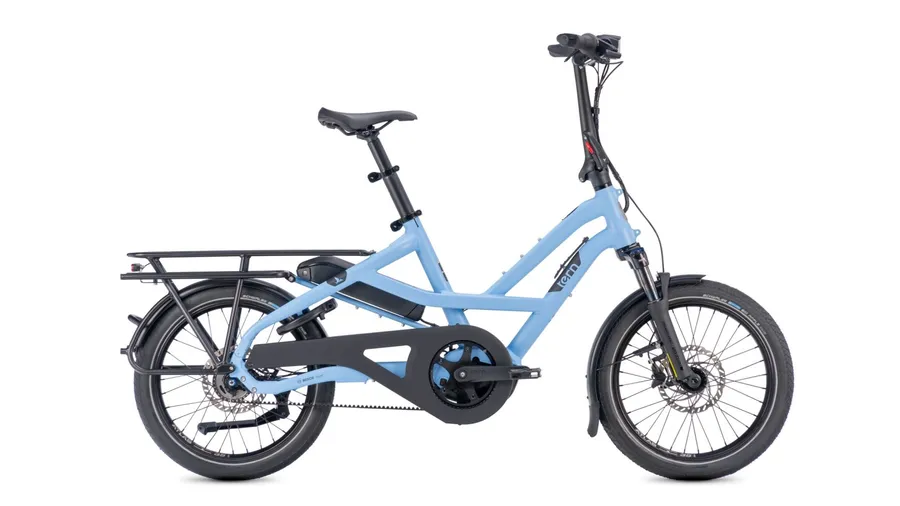
5-speed Shimano Nexus hub and Gates belt: almost no maintenance. For flat city riding and short trips.
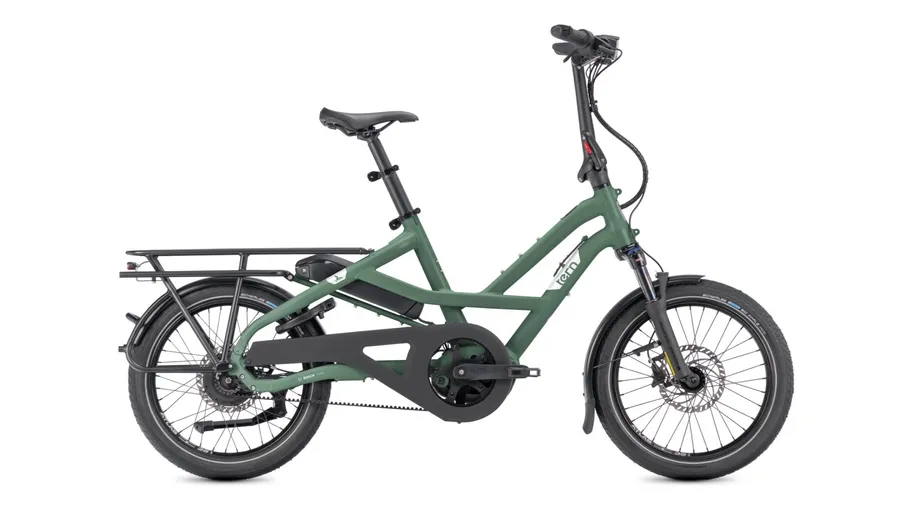
Enviolo stepless hub and Gates belt: you can change gear even when stopped at a red light.
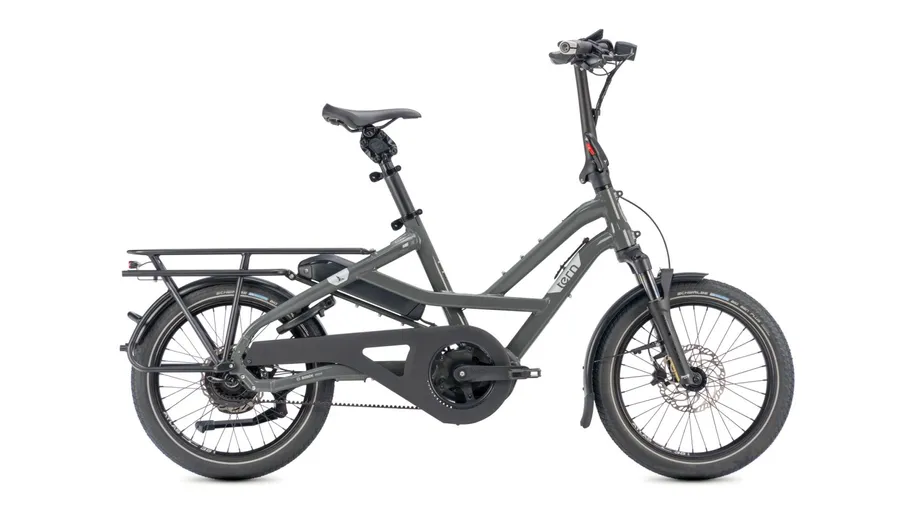
The top model: 90 Nm Bosch Performance Line PX motor, 9-speed 3x3 Nine hub and Bosch eShift.
How to choose?
Is a Gen 2 HSD still worth buying?
If you mostly ride on flat ground, alone or with a young child, the HSD P10 Gen 2 does the same job for €200 less. The P10e is worth the difference if you carry heavy loads, are taller than 1.95 m or weigh more than 120 kg, or want to forget about derailleur cable adjustments.
Can automatic shifting be turned off?
Yes. Automatic mode is optional: you can shift yourself at any time with the handlebar control, just like a conventional derailleur.
Will my Gen 2 HSD accessories fit Gen 3?
Not necessarily all of them. Tern has renewed part of the range (Clubhouse Mini, Storm Box Mini, Sidekick Footrests) and added the Hardshell Hauler, a 26-litre lockable hard case. Bring the list of your accessories to the shop: we'll check compatibility before you buy anything. Our article on the Tern range and its accessories already covers the most common pitfalls.
What about the HSD P10e Sport mentioned in the press?
That is a North American version, with assistance up to 45 km/h. It isn't offered in Belgium, where the P10e is limited to 25 km/h, like any e-bike that isn't a speed pedelec.
How does the P10e differ from the other Gen 3 HSD models?
The P10e is the only one with a derailleur, which gives it a wide gear range at a reasonable price. The P5i and P00 use a belt and an internal gear hub, for less maintenance. The S9i adds a more powerful motor for hills and heavy loads.
Want to compare both generations?
The HSD Gen 3 is in our online catalogue. Drop by the shop to try automatic shifting and ask your questions.