
In a fully self-supported race, kit is chosen on a single criterion: what lets you keep riding when things go wrong. The Taurus Mountain Race rules impose a precise list, checked before the start. The rest comes down to trade-offs between weight, reliability and comfort, bearing in mind that whatever you take, you have to carry.
I'm Adrien, manager of the KAMEO shop in Brussels, and I'll be on the start line of this 1,460 km race in Turkey. Here's how I make my choices, item by item.
Second instalment of a four-part series. The mandatory kit comes from the Race Manual 2026, a preliminary version reserved for registered riders, consulted in September 2026. The rest is down to personal choice.
2.4"
tyre width, when the rules require 2.0
30 × 10-52
my drivetrain: well below the required 1:1 ratio
-5 °C
the temperature the sleep system has to cover
The bike
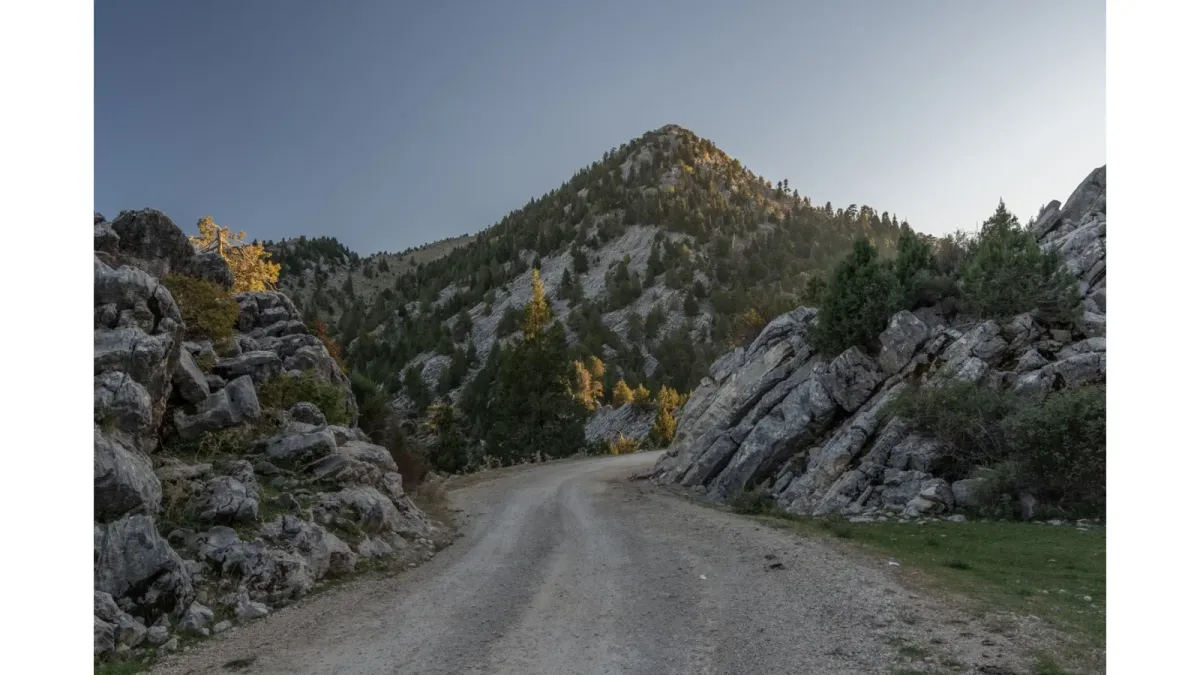
The mountains of the Taurus range: the playground for the next ten days, and what dictates every choice that follows.
I'm riding a custom-made titanium frame. It's a little heavier than carbon, but it's comfortable, I can load it up without a second thought, and I'm not afraid of breaking anything on it. For this kind of race, it's ideal.
As for gearing, it's what makes the difference between climbing slowly and pushing on foot. In my case, a 30-tooth chainring and a 10-52 cassette. And 2.4-inch tyres, just over 60 millimetres: I'd rather have some margin. I've already torn a tyre on a piece of glass at the roadside; it can be fixed, but it's far from a given.
The bags
Nothing is mandatory, but I have one rule: as little weight as possible on the handlebar. At low speed, weight up front has a direct effect on handling. It's a mass that pulls the steering, and on a track you pay for it.
How I split the load
→ frame bag — most of the volume, central and low
→ fixed seat pack (Tailfin-style) — the sleep system, at the rear
→ top tube bags — what needs to stay within reach
→ handlebar — snacks only, as light as possible
I've never had a bag fail on me during a race, but it happens, especially with seat packs. Watching other riders quickly taught me that it's the mounts that give way first, not the fabric. My frame bag is made of Dyneema: weight for weight, this fabric is stronger than steel, which lets you gain strength without making the bike heavier.
Tools and repairs
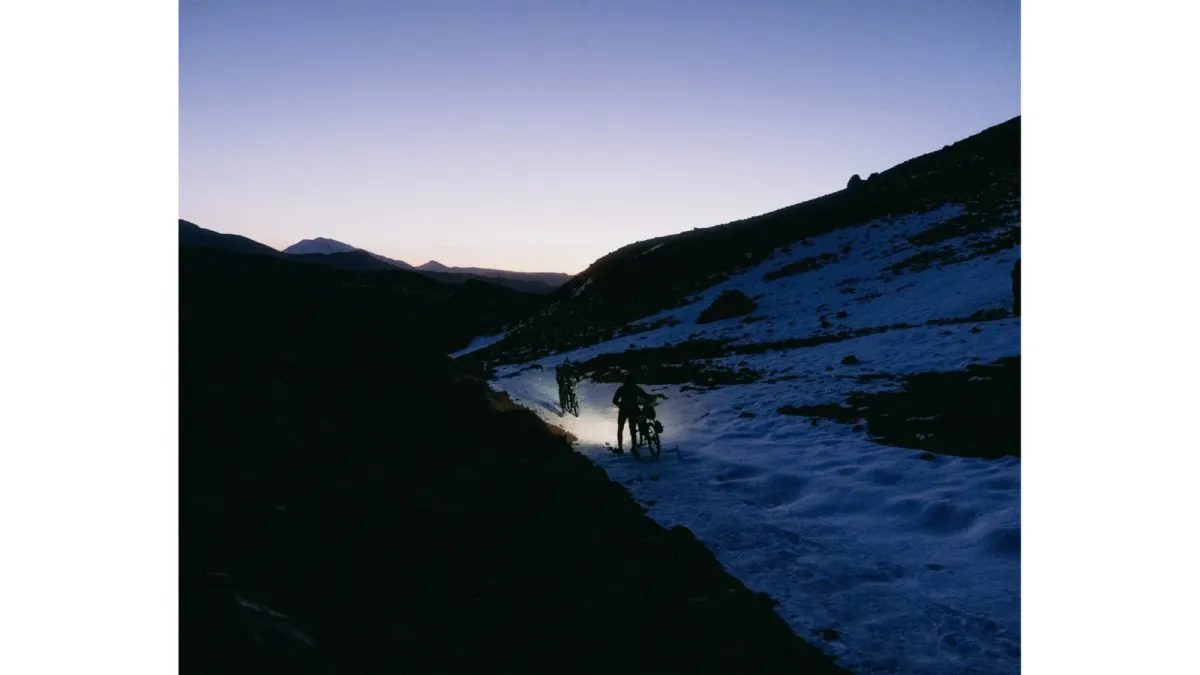
Riding through snow. This is exactly the kind of moment the mandatory kit list exists for.
The rules impose only one thing: a spare derailleur hanger. Specific to each bike, impossible to find locally, and without it you can say goodbye to the finish line.
What I add on top
→ a big multi-tool, tubeless plugs, glue
→ fishing line to stitch a tyre, chain links
→ batteries for the derailleurs, spare brake pads
→ zip ties, string, a lighter and a whole host of other "odds and ends"
The most unlikely repair I've ever done? A rear disc that kept working itself loose: with the vibrations, the lockring was developing play. I ended up sliding my knife blade into the splines and tightening it by hand, with the help of some stones, at the top and bottom of every descent. It's makeshift, but it let me finish the last three days of a race.
Clothing, sleep system, safety
From +30 °C in the valleys to -5 °C at altitude. When it comes to clothing, the rules don't just protect you from the cold: they protect your ability to warm back up.
Waterproofs jacket and overtrousers, both mandatory
Insulation a down jacket or its synthetic equivalent
Two pairs of gloves a warm pair to keep your hands working, a waterproof pair so the first doesn't get soaked
Sleep system sleeping bag, mat, bivy bag: enough to sleep outdoors if I have no choice
Safety helmet at all times, front and rear lights, first-aid kit, survival blanket, water purification
SPOT tracker mandatory satellite tracking, with the SOS function reserved for life-threatening danger
The questions I get asked
Titanium, carbon or steel for this kind of event?
None of them rules you out. Titanium gives me comfort and a tolerance for load that I don't find elsewhere, without the fear of impact I'd have with a loaded carbon frame on tracks. It's a choice for peace of mind rather than performance.
One part you absolutely mustn't forget?
The spare derailleur hanger. It's specific to each frame model, you won't find one in any village grocery, and without it a run-of-the-mill crash ends your race. It's also the only part the rules make mandatory.
Why so little weight on the handlebar?
Because at low speed, on a steep climb or a technical descent, a mass up front pulls the steering and makes the bike unpredictable. On the handlebar I only carry snacks and what I need while riding; the volume goes in the frame and at the rear.
What fails first on a bag?
The mounts, almost always, and especially on seat packs. The fabric holds. That's why a rigid system fixed to the rear axle is more reassuring than a strap around the seatpost, and why you should check your attachment points at every stop.
The rest of the series
→ #1 — The race explained: route, self-support, weather
→ #3 — The preparation: training and sleep
→ #4 — Nutrition: eating and drinking self-supported
Our sources
Mandatory kit list, sleep system requirements, bike recommendations, pre-start check and use of the satellite tracker: Taurus Mountain Race — Race Manual 2026, preliminary version for registered riders, Silk Road Mountain Race LTD (themountainraces.cc).
Personal choices, race experience and breakdowns seen on loaded bikes: personal experience and the KAMEO Bikes workshops in Liège and Brussels.
Questions about preparing your trip?
Send us your kit list: we'll go through it with you before you set off.